Pakistan Manufacturing Policy 2026: Structure, Incentives, and Economic Impact
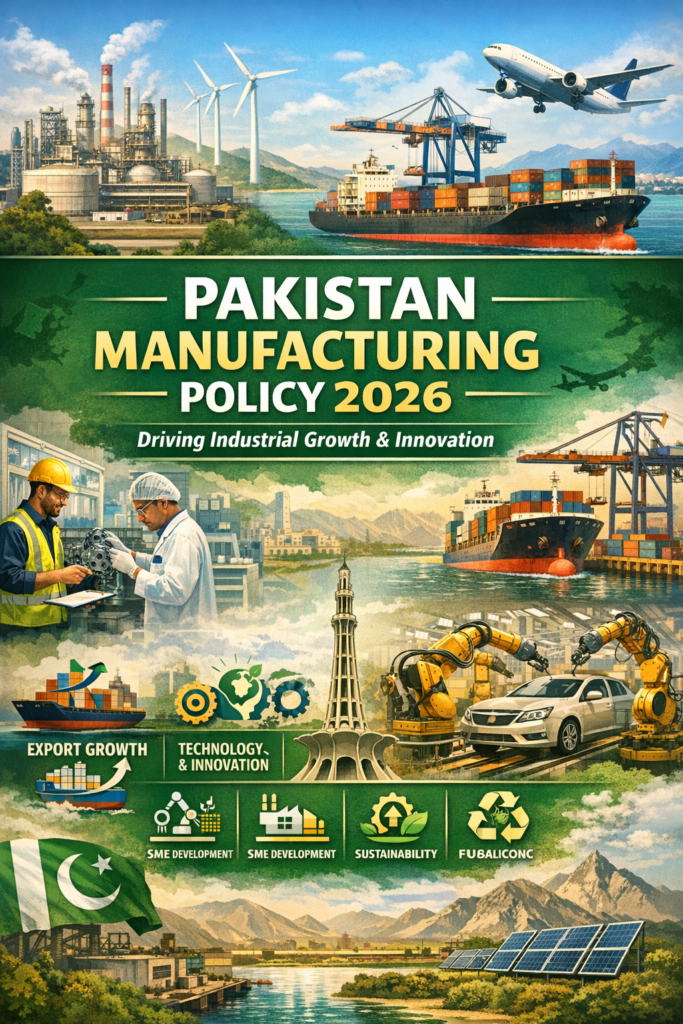
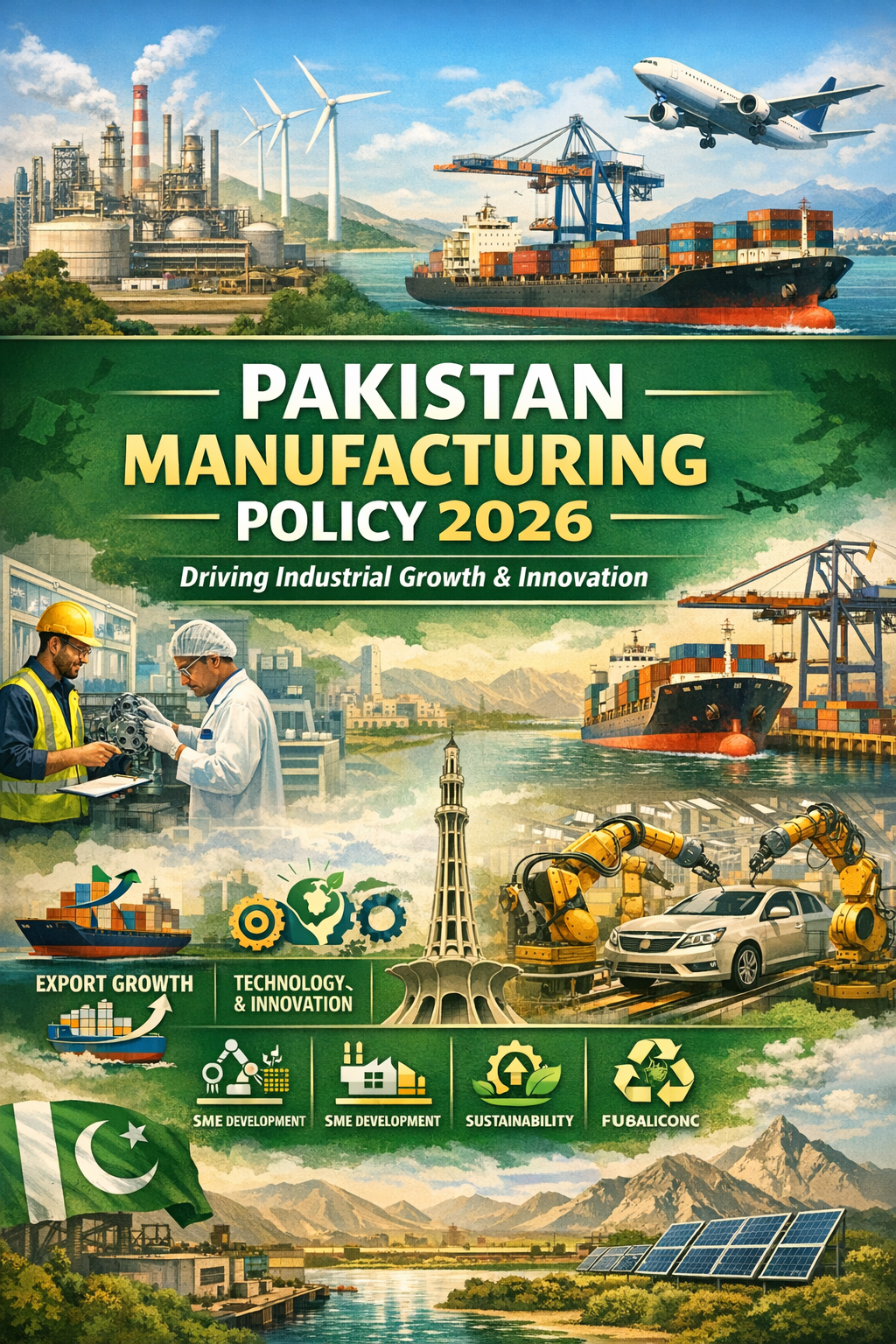
The Pakistan Manufacturing Policy 2026 represents a strategic attempt to reverse long-term deindustrialization, raise export competitiveness, and reposition Pakistan as a regional manufacturing hub. Designed under the direction of the :contentReference[oaicite:0]{index=0}, the policy addresses structural inefficiencies that have historically constrained industrial growth, including high energy costs, weak productivity, import dependence, and limited technological upgrading.
This policy is not a single legislative act but a coordinated framework combining fiscal incentives, regulatory reform, infrastructure development, and trade facilitation. Its overarching aim is to raise manufacturing’s contribution to GDP, improve value addition, expand exports, and generate sustainable employment by 2026 and beyond.
1. Background and Rationale
Pakistan’s manufacturing sector has underperformed relative to peer economies. While countries such as Vietnam, Bangladesh, and Indonesia expanded industrial exports through scale, specialization, and integration into global value chains, Pakistan remained dependent on low-value textiles and imported intermediate goods. Manufacturing growth remained volatile, constrained by macroeconomic instability and policy inconsistency.
The Manufacturing Policy 2026 emerges in response to three core realities:
- Persistent trade deficits driven by import-heavy consumption
- Low technological depth in domestic industries
- Insufficient formal employment creation for a growing labor force
The policy recognizes manufacturing as the only sector capable of absorbing labor at scale while simultaneously generating exportable surplus.
2. Core Objectives of the Manufacturing Policy 2026
The policy is structured around clearly defined macro and sector-level objectives:
- Increase manufacturing’s share of GDP to above 15%
- Expand export-oriented manufacturing
- Reduce import dependence through local substitution
- Promote technology-intensive and value-added production
- Create high-quality formal employment
Unlike earlier industrial policies, the 2026 framework emphasizes outcomes over protectionism. Incentives are conditional on performance metrics such as exports, productivity gains, and localization.
3. Priority Manufacturing Sectors
The policy identifies priority sectors based on export potential, domestic demand, and technological spillovers:
3.1 Textiles and Apparel (Value-Added Focus)
Rather than expanding raw yarn and greige fabric production, the policy prioritizes garments, technical textiles, and branded exports. Incentives are tied to downstream integration, compliance standards, and design capabilities.
3.2 Engineering and Auto Parts
Localization of auto parts, agricultural machinery, and light engineering goods is a key pillar. Vendor development programs and cluster-based industrial zones are intended to reduce reliance on imported components.
3.3 Pharmaceuticals and Chemicals
The policy promotes domestic production of Active Pharmaceutical Ingredients (APIs) and specialty chemicals to address supply chain vulnerabilities exposed during global disruptions.
3.4 Electronics and Electrical Goods
Assembly-to-manufacturing transition is central here. Firms are encouraged to move from simple assembly to component manufacturing through phased localization targets.
3.5 Agro-Processing and Food Manufacturing
Value addition in agriculture through food processing, cold chains, and packaging is positioned as a means to stabilize farmer incomes and increase exports.
4. Fiscal and Tax Incentives
Manufacturing Policy 2026 introduces targeted fiscal measures rather than blanket tax exemptions:
- Reduced corporate tax rates for export-oriented manufacturers
- Accelerated depreciation for machinery and plant investment
- Sales tax zero-rating for selected manufacturing exports
- Duty-free import of capital goods not produced locally
Crucially, incentives are time-bound and performance-linked, reducing long-term fiscal distortions while encouraging efficiency.
5. Energy and Infrastructure Reforms
High energy tariffs historically eroded Pakistan’s manufacturing competitiveness. The 2026 policy includes:
- Regionally competitive electricity and gas pricing for industry
- Dedicated industrial feeders to reduce outages
- Encouragement of captive renewable energy solutions
Industrial zones under Special Economic Zones (SEZs) are integrated with logistics infrastructure, ports, and digital connectivity to minimize transaction costs.
6. Trade and Export Facilitation
Export-led manufacturing is a central theme. The policy aligns tariff structures, export finance, and customs procedures to support exporters:
- Simplified customs clearance and risk-based inspections
- Enhanced export refinance schemes
- Market access support through trade diplomacy
A shift from import substitution to competitive export manufacturing marks a significant philosophical change.
7. Technology, Innovation, and Skills
Recognizing that low productivity stems from technological stagnation, the policy prioritizes:
- Technology Upgradation Funds
- Public-private R&D collaboration
- Industry-linked vocational and technical training
Skill development is aligned with actual industry demand rather than generic training programs, addressing a persistent mismatch in the labor market.
8. SME Integration and Industrial Clusters
Small and Medium Enterprises (SMEs) are integrated into value chains through cluster-based development:
- Shared facilities and testing labs
- Access to formal credit
- Digitalization of SME operations
This approach improves scale efficiencies while preserving entrepreneurial flexibility.
9. Environmental and Sustainability Framework
Manufacturing Policy 2026 explicitly incorporates sustainability:
- Cleaner production standards
- Waste management and recycling incentives
- Energy efficiency benchmarks
Environmental compliance is framed as a competitiveness requirement rather than a regulatory burden, particularly for export markets.
10. Governance, Monitoring, and Implementation
Past industrial policies failed largely due to weak implementation. The 2026 policy introduces:
- Centralized monitoring dashboards
- Inter-ministerial coordination mechanisms
- Private sector advisory councils
Regular performance reviews allow recalibration rather than rigid adherence to ineffective measures.
11. Challenges and Risks
Despite its comprehensive design, the policy faces structural risks:
- Macroeconomic instability and currency volatility
- Political discontinuity
- Capacity constraints in implementation agencies
Success depends on policy consistency, fiscal discipline, and sustained reform momentum.
12. Expected Economic Impact
If effectively implemented, Manufacturing Policy 2026 is expected to:
- Increase industrial employment significantly
- Improve export diversification
- Reduce current account pressures
- Strengthen domestic value chains
The long-term payoff lies not just in higher output, but in structural transformation toward a more resilient and productive economy.
Conclusion
Pakistan Manufacturing Policy 2026 represents a pragmatic shift from protectionist industrialization toward performance-driven manufacturing growth. By aligning incentives with productivity, exports, and sustainability, it attempts to correct decades of structural imbalance. While execution risks remain substantial, the policy provides a coherent framework that, if sustained, can redefine Pakistan’s industrial trajectory over the next decade.