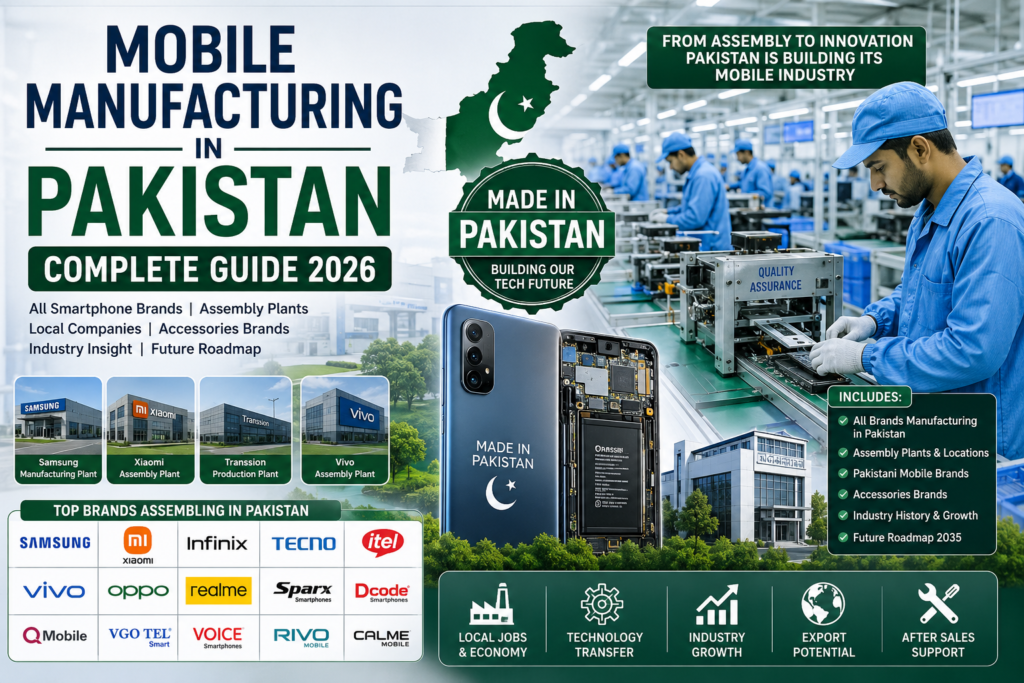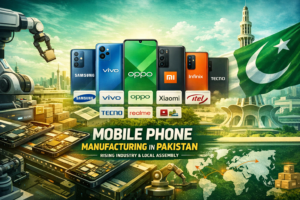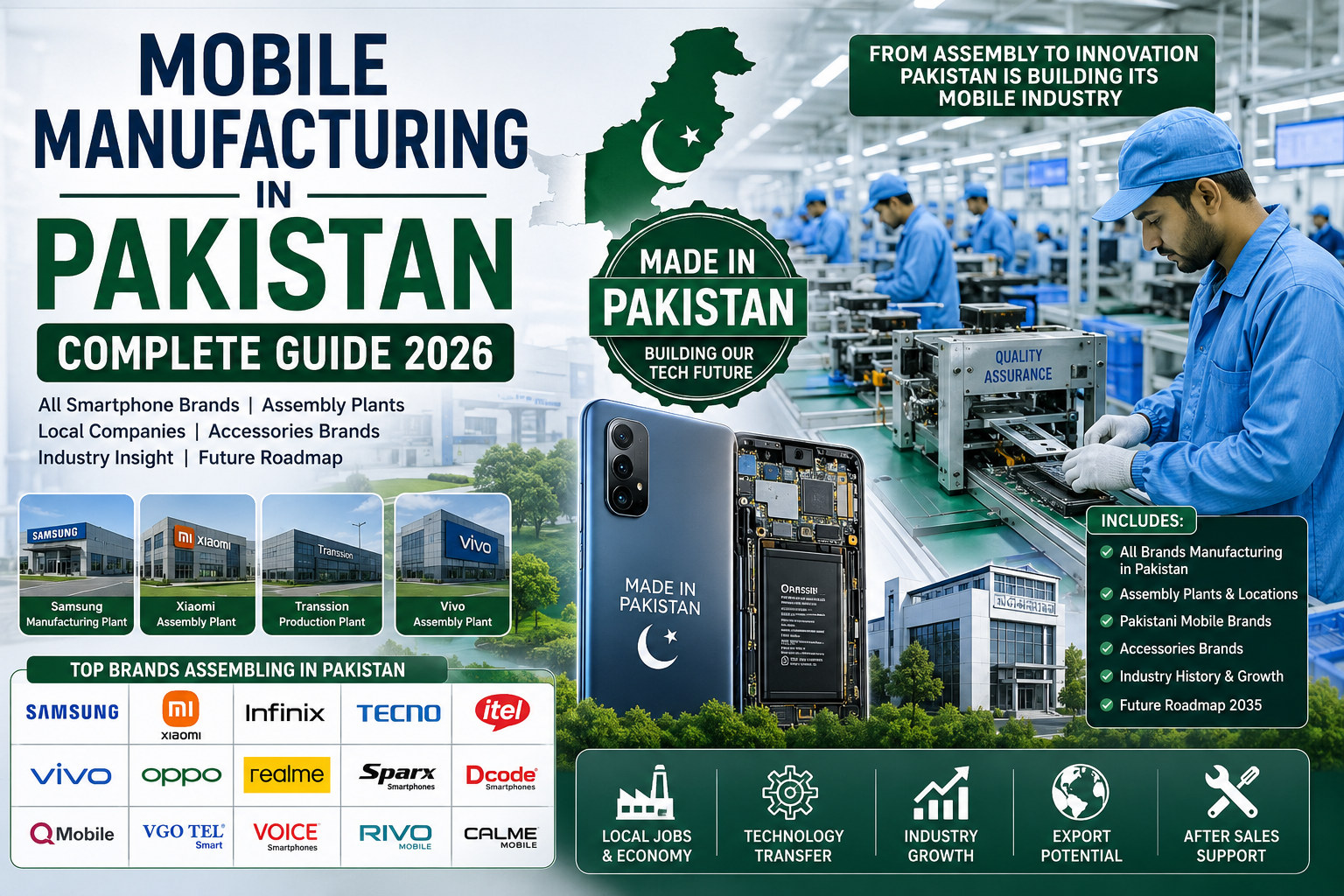
Mobile Manufacturing in Pakistan
The Complete History of Pakistan’s Smartphone Manufacturing Industry (2000–2026)
Published by: WhatMobilePK
Pakistan has transformed from a country that relied almost entirely on imported mobile phones into one of South Asia’s fastest-growing mobile assembly hubs. Within only a few years, dozens of smartphone brands established local manufacturing or assembly operations, resulting in millions of devices being produced annually.
The country’s mobile industry now supports thousands of jobs, attracts foreign investment, reduces import dependency, and creates opportunities for local vendors and technology companies.
This comprehensive guide explores Pakistan’s entire mobile manufacturing journey—from the era of imported feature phones to the rise of local smartphone production. We also examine every major brand manufacturing in Pakistan, former manufacturers, closed factories, future projects, government policies, and the industry’s future outlook.
Table of Contents
- History of Mobile Phones in Pakistan
- When Mobile Manufacturing Started
- Government Policies
- PTA and Mobile Manufacturing Authorization
- How Phones are Manufactured
- Difference Between Assembly and Manufacturing
- Major Manufacturing Companies
- International Brands Manufacturing in Pakistan
- Pakistani Smartphone Brands
- Former Manufacturers and Closed Plants
- Future Manufacturing Projects
- Economic Impact
- Employment Opportunities
- Future of Pakistan’s Smartphone Industry
- Frequently Asked Questions
Introduction
Pakistan is one of the world’s largest smartphone markets, with over 190 million cellular subscriptions and more than 140 million broadband users. Demand for affordable smartphones has increased rapidly because of digital banking, online education, e-commerce, freelancing, gaming, and government digital initiatives.
For many years nearly every smartphone sold in Pakistan was imported from China, Vietnam, India, and South Korea. This resulted in heavy import bills and pressure on foreign exchange reserves.
To solve this challenge, the Government of Pakistan introduced policies encouraging local mobile manufacturing and assembly. The results exceeded expectations. Global brands quickly partnered with Pakistani companies to establish assembly plants across the country.
Today Pakistan assembles millions of smartphones every year, making it one of the fastest-growing mobile manufacturing markets in the region.
History of Mobile Phones in Pakistan
Mobile communication became popular in Pakistan during the early 2000s when Nokia, Motorola, Siemens, Sony Ericsson, Samsung and LG dominated the market.
At that time every handset was imported. Local businesses acted only as distributors, wholesalers and retailers.
Feature phones remained the most common devices until Android smartphones entered the market around 2010.
The rapid expansion of 3G and 4G services after 2014 dramatically increased smartphone demand. Millions of Pakistanis upgraded from keypad phones to Android smartphones, creating a massive opportunity for manufacturers.
Government Support for Manufacturing
Recognizing the growing demand, Pakistan introduced several initiatives encouraging local assembly instead of importing finished devices.
The Mobile Device Manufacturing Policy provided incentives for companies willing to establish local production facilities. The policy reduced dependency on imports while encouraging technology transfer and employment generation.
How Mobile Manufacturing Works
Many people believe every smartphone produced in Pakistan is built entirely from raw materials. In reality, most facilities currently operate using CKD (Completely Knocked Down) or SKD (Semi Knocked Down) manufacturing models.
Individual components—including displays, processors, camera modules, batteries, memory chips, and printed circuit boards—are imported from international suppliers.
Inside Pakistani factories these components undergo:
- PCB Assembly
- Mainboard Testing
- Display Installation
- Camera Installation
- Battery Installation
- Software Flashing
- Quality Inspection
- Packaging
Every finished smartphone passes through multiple quality control stages before reaching retailers across Pakistan.
Assembly vs Manufacturing
| Assembly | Manufacturing |
|---|---|
| Imports major components | Produces components locally |
| Lower investment | Very high investment |
| Faster production | Long-term industrial growth |
| Current model used by most Pakistani plants | Future objective for Pakistan |
Timeline of Pakistan’s Mobile Manufacturing Industry
| Year | Major Development |
|---|---|
| 2000–2010 | Almost all phones imported |
| 2014 | 3G & 4G launch increases smartphone demand |
| 2017 | Government begins promoting local manufacturing |
| 2019 | Major brands start evaluating Pakistan for assembly |
| 2020 | Local smartphone production accelerates |
| 2021 | Samsung begins local assembly through Lucky Motor Corporation |
| 2022 | Production exceeds imported smartphone volume |
| 2023 | Multiple Chinese brands expand local production |
| 2024 | New domestic brands continue entering manufacturing |
| 2025–2026 | Focus shifts toward localization and export opportunities |
The Rise of Local Manufacturing
One of the biggest turning points in Pakistan’s smartphone industry came when global manufacturers realized that local assembly could significantly reduce import duties, improve product availability, and shorten supply chains.
Instead of importing fully assembled smartphones, companies started shipping components to Pakistan, where trained engineers assembled devices locally using internationally certified manufacturing procedures.
This shift benefited manufacturers, retailers, consumers, and the national economy alike. Consumers gained access to competitively priced smartphones, while thousands of new technical and manufacturing jobs were created.
The success of these early assembly plants encouraged additional global brands to enter the Pakistani market, laying the foundation for one of the country’s fastest-growing technology sectors.
“` “`htmlMajor Mobile Brands Manufacturing in Pakistan
Pakistan’s mobile manufacturing sector has expanded rapidly over the last few years. Today, international smartphone brands and local companies assemble millions of smartphones annually through partnerships with Pakistani manufacturers. While most production follows the Completely Knocked Down (CKD) or Semi Knocked Down (SKD) model, several factories continue increasing local value addition by sourcing packaging materials, chargers, cables, batteries, and accessories domestically.
Below is a detailed overview of the major brands manufacturing or assembling smartphones in Pakistan.
Samsung Pakistan
Samsung became one of the biggest milestones in Pakistan’s mobile manufacturing industry when it announced local smartphone assembly through Lucky Motor Corporation (LMC). The partnership demonstrated that Pakistan was capable of producing smartphones meeting Samsung’s global quality standards.
Lucky Motor Corporation established modern assembly facilities capable of producing numerous Galaxy A-series smartphones for the local market.
Locally Assembled Samsung Devices
- Galaxy A04
- Galaxy A04e
- Galaxy A05
- Galaxy A05s
- Galaxy A06
- Galaxy A14
- Galaxy A15
- Galaxy A16
- Galaxy A24
- Galaxy A25
- Galaxy A34
- Galaxy A35
- Galaxy A54 (selected variants)
Manufacturing Partner
- Lucky Motor Corporation
- Location: Bin Qasim Industrial Area, Karachi
Samsung’s local assembly significantly reduced import dependency and improved product availability across Pakistan.
Xiaomi Pakistan
Xiaomi entered Pakistan with aggressive pricing and quickly became one of the country’s best-selling smartphone brands. To reduce costs and improve supply, Xiaomi partnered with local manufacturing companies for assembly operations.
Today, numerous Redmi and Poco devices sold in Pakistan are assembled locally.
Popular Locally Assembled Xiaomi Phones
- Redmi A3
- Redmi A5
- Redmi 13C
- Redmi 14C
- Redmi Note 13 Series
- Redmi Note 14 Series
- Poco C Series
- Poco M Series
Local manufacturing enables Xiaomi to remain one of Pakistan’s most competitive smartphone brands.
Infinix Pakistan
Infinix is among Pakistan’s highest-selling smartphone brands. Operated under Transsion Holdings, the company invested heavily in local production through Pakistani manufacturing partners.
Today most entry-level and mid-range Infinix smartphones available in Pakistan are assembled locally.
Popular Locally Produced Models
- Infinix Smart Series
- Hot Series
- Note Series
- Zero Series
- GT Series
The company’s manufacturing operations support thousands of jobs in assembly, testing, logistics, warehousing, and distribution.
Tecno Mobile Pakistan
Tecno has experienced remarkable growth in Pakistan’s smartphone market. By producing smartphones locally, the company successfully reduced retail prices while improving inventory availability.
Tecno manufactures numerous Spark, Pop, Camon, Pova, and Phantom devices locally through its Pakistani manufacturing network.
Major Series
- Spark Series
- Camon Series
- Pop Series
- Pova Series
- Phantom Series
Tecno continues expanding its local manufacturing operations as demand increases.
itel Pakistan
itel primarily focuses on affordable smartphones and feature phones. Local assembly allows the company to offer competitive prices while reaching consumers across urban and rural Pakistan.
Manufactured Devices
- itel A Series
- itel Vision Series
- itel P Series
- itel S Series
itel remains one of Pakistan’s leading entry-level smartphone brands.
OPPO Pakistan
OPPO established itself as a premium smartphone brand before expanding into local assembly. Local production reduced delivery times and improved supply for the popular A Series and Reno Series smartphones.
Popular Models
- OPPO A18
- OPPO A38
- OPPO A60
- OPPO Reno Series (selected variants)
OPPO continues increasing localization while maintaining strict global quality standards.
Vivo Pakistan
Vivo entered Pakistan with strong marketing and quickly became one of the country’s largest smartphone brands. The company manufactures several Y Series and V Series smartphones locally.
- Vivo Y03
- Vivo Y18
- Vivo Y28
- Vivo Y39
- Vivo V40 Lite
Local manufacturing enables Vivo to compete aggressively with Samsung, Xiaomi, Infinix, and Tecno.
Realme Pakistan
Realme expanded rapidly in Pakistan after establishing partnerships for local smartphone assembly. The company focuses on affordable 5G and gaming smartphones.
- Realme C Series
- Realme Note Series
- Realme Narzo Series
- Realme Number Series
Nokia (HMD Global)
HMD Global also utilizes Pakistani manufacturing facilities for selected Nokia smartphones and feature phones. Local assembly improves product affordability while maintaining Nokia’s reputation for reliability.
- Nokia C Series
- Nokia G Series
- Nokia Feature Phones
Motorola
Motorola has gradually returned to Pakistan through official distribution partners. While its portfolio is smaller than other brands, local assembly has been explored for selected budget and mid-range devices.
ZTE & Nubia
ZTE and its gaming-focused Nubia brand have expanded their presence in Pakistan through official distributors. Selected entry-level and mid-range devices are assembled locally depending on production demand and market availability.
Honor
Following its separation from Huawei, Honor re-entered Pakistan with renewed focus on affordable and premium smartphones. Some devices are assembled locally through authorized manufacturing partners to improve availability and pricing.
Local Value Addition
Although processors, displays, memory chips, and camera sensors are still largely imported, Pakistan has made progress in local value addition through the domestic production of:
- Retail Packaging Boxes
- User Manuals
- USB Cables
- Wall Chargers
- Power Adapters
- Protective Covers
- Screen Protectors
- Labels and Packaging Materials
- Quality Testing Equipment Integration
Government initiatives encourage manufacturers to increase localization over time, with the long-term objective of producing more smartphone components within Pakistan instead of importing nearly all parts.
Pakistani Smartphone Brands Manufacturing Locally
Although international companies dominate Pakistan’s smartphone market, several domestic brands have played an important role in developing the country’s mobile ecosystem. Some began as importers before moving into local assembly, while others were created specifically to take advantage of Pakistan’s Mobile Device Manufacturing Policy.
These companies primarily target budget-conscious consumers by offering affordable Android smartphones, feature phones, and entry-level smart devices. While many rely on Original Design Manufacturers (ODMs) in China for hardware design, local assembly has enabled them to reduce prices, improve availability, and create employment opportunities within Pakistan.
Sparx Mobile
Sparx has become one of Pakistan’s fastest-growing smartphone brands. Owned by Deploy Group, the company focuses on affordable smartphones with modern specifications, including high-refresh-rate displays, large batteries, AI cameras, and fast charging technologies.
Unlike many earlier Pakistani brands that concentrated solely on feature phones, Sparx entered the Android market with a clear strategy of competing directly against Infinix, Tecno, Xiaomi, and Samsung in the entry-level and mid-range segments.
Popular Sparx Smartphones
- Sparx Neo Series
- Sparx Edge Series
- Sparx Ultra Series
- Sparx Note Series
Strengths
- Affordable pricing
- Modern Android interface
- Large batteries
- Competitive camera hardware
- Strong nationwide distribution
Dcode Mobile
Dcode is one of Pakistan’s newest smartphone brands. The company focuses on combining premium-looking designs with competitive hardware while maintaining aggressive pricing.
Instead of competing purely on low prices, Dcode emphasizes display quality, memory capacity, and attractive industrial design.
Popular Devices
- Dcode X
- Dcode Cypher
- Dcode Bold Series
- Dcode Cygnal Series
The company continues expanding its portfolio with improved software support and larger storage configurations.
VGO TEL
VGO TEL has steadily expanded its presence in Pakistan by targeting consumers seeking affordable smartphones without sacrificing essential features.
The company manufactures and assembles several Android smartphones alongside feature phones for the domestic market.
Popular Series
- Smart Series
- Note Series
- New Series
- Flex Series
QMobile
QMobile was once Pakistan’s largest mobile phone company. During the feature phone era, the company controlled a significant portion of the domestic market and became a household name.
The company introduced hundreds of models ranging from ultra-budget feature phones to Android smartphones. At its peak, QMobile outsold many international brands.
Popular Devices
- QMobile Noir Series
- QMobile Smart Series
- QMobile LT Series
- QMobile Energy Series
However, increased competition from Chinese smartphone manufacturers gradually reduced QMobile’s market share.
GFive
GFive established a strong reputation during Pakistan’s feature phone era by offering durable and affordable devices with long battery life.
Although the company later introduced Android smartphones, it struggled against rapidly advancing competitors such as Xiaomi, Infinix, Tecno, and Samsung.
Calme
Calme entered Pakistan’s smartphone market by focusing on stylish yet affordable Android devices. The company enjoyed moderate success before facing increased competition from global manufacturers.
Voice Mobile
Voice Mobile was another well-known Pakistani smartphone brand that achieved popularity during the transition from feature phones to Android smartphones.
The company launched numerous affordable devices featuring dual SIM support, large displays, and competitive pricing.
Rivo Mobile
Rivo Mobile became well known for affordable smartphones and feature phones aimed at first-time smartphone buyers.
The company competed aggressively with QMobile and GFive before gradually losing market share to international brands.
Other Pakistani Brands
- Club Mobile
- Haier Mobile
- Orient Mobile
- Jazz Digit Smartphones
- Mobilink branded devices
- United Mobile
Some of these brands focused on feature phones, while others experimented with Android smartphones before exiting the market or reducing operations.
Why Pakistani Brands Struggled
Despite early success, many domestic smartphone companies faced significant challenges that affected long-term sustainability.
| Challenge | Impact |
|---|---|
| Chinese Competition | Lower prices and better hardware |
| Limited R&D | Slower innovation |
| Weak Software Support | Reduced consumer confidence |
| Marketing Budgets | Unable to compete with global brands |
| Supply Chain Issues | Higher production costs |
| Currency Depreciation | Increased import costs |
Contribution of Pakistani Brands
Although many local brands have lost market share, they played an important role in introducing affordable smartphones to millions of Pakistanis. These companies helped accelerate smartphone adoption, expanded retail networks, and demonstrated that local entrepreneurship could compete in the electronics industry.
Today’s emerging brands such as Sparx, Dcode, and VGO TEL continue building upon that legacy with improved designs, stronger distribution, and better manufacturing partnerships.
“` “`html id=”pkmfg-part4″Former Mobile Brands and Discontinued Operations in Pakistan
Pakistan’s mobile phone industry has experienced remarkable growth over the past two decades. While many brands have become successful through local assembly and manufacturing, numerous companies that once dominated the market have either disappeared, significantly reduced their operations, or shifted their business strategies.
The reasons behind these closures vary from increasing international competition and changing consumer preferences to currency depreciation, rising production costs, limited software support, and rapid technological advancements.
Understanding the rise and decline of these companies provides valuable insight into Pakistan’s evolving smartphone ecosystem.
QMobile – From Market Leader to Declining Brand
For nearly a decade, QMobile was Pakistan’s largest mobile phone brand. During its peak years, the company offered one of the country’s widest smartphone and feature phone portfolios.
Its strategy focused on importing affordable devices from Original Design Manufacturers (ODMs), rebranding them under the QMobile name, and distributing them nationwide.
Why QMobile Became Successful
- Extensive dealer network
- Affordable pricing
- Aggressive television advertising
- Large feature phone portfolio
- Early Android adoption
- Strong brand recognition
Reasons for Decline
- Rapid expansion of Xiaomi, Infinix, Tecno and Vivo
- Limited software updates
- Weak premium smartphone lineup
- Increasing import costs
- Changing consumer preferences
- Reduced investment in research and development
Although QMobile products are still available in limited numbers, the company no longer dominates Pakistan’s smartphone market as it once did.
Voice Mobile
Voice Mobile gained popularity during Pakistan’s transition from feature phones to Android smartphones.
Its devices were widely sold through local retailers and appealed to consumers looking for affordable Android experiences.
However, stronger competition from Chinese smartphone manufacturers gradually reduced the company’s market presence.
Rivo Mobile
Rivo Mobile introduced several affordable Android smartphones and feature phones during the early growth of Pakistan’s smartphone market.
Despite initial success, limited hardware innovation and increasing competition prevented the company from maintaining long-term growth.
Calme
Calme launched multiple Android smartphones targeting entry-level buyers.
Although its devices offered competitive prices, the company struggled to match the hardware specifications and software support provided by rapidly expanding Chinese brands.
GFive
GFive enjoyed strong sales during the feature phone era. Long battery life, affordable pricing, and durable construction made the brand popular across Pakistan.
As smartphone technology advanced, GFive was unable to compete effectively with manufacturers investing heavily in research, development, and software optimization.
Haier Mobile
Haier attempted to expand beyond consumer electronics by introducing smartphones and feature phones in Pakistan.
Although the company maintained a presence for several years, smartphones never became a major part of its overall business strategy.
Club Mobile
Club Mobile introduced various affordable Android smartphones during Pakistan’s early smartphone adoption period.
The company eventually reduced its smartphone operations as competition intensified.
Orient Mobile
Orient diversified into smartphones after establishing itself in Pakistan’s home appliance market.
Despite launching several Android devices, smartphones remained a relatively small segment of its overall business.
Feature Phone Brands That Lost Relevance
Several feature phone companies experienced declining sales after Android smartphones became increasingly affordable.
| Brand | Main Reason |
|---|---|
| QMobile Feature Phones | Shift toward smartphones |
| Voice | Android competition |
| GFive | Changing consumer demand |
| Calme | Limited innovation |
| Rivo | Market competition |
| Club Mobile | Reduced investment |
Did Pakistan Have “Dead” Mobile Manufacturing Plants?
Unlike the automotive sector, Pakistan has witnessed relatively few permanently abandoned smartphone manufacturing facilities.
Instead, the industry has experienced a different trend:
- Factories changing manufacturing partners
- Assembly lines switching brands
- Production temporarily suspended because of import restrictions
- Facilities upgraded to manufacture newer smartphones
- Contract manufacturers replacing older clients with new brands
This flexibility has allowed many manufacturing facilities to continue operating despite changing market conditions.
Temporary Production Slowdowns
Pakistan’s smartphone manufacturing sector has occasionally experienced temporary slowdowns rather than permanent closures.
Major Causes
- Foreign exchange shortages
- Import restrictions
- Delayed Letters of Credit (LCs)
- Currency depreciation
- Global semiconductor shortages
- COVID-19 supply chain disruptions
Most manufacturers resumed production once supply chains stabilized.
Lessons Learned from Former Brands
The decline of earlier Pakistani smartphone companies provides valuable lessons for today’s manufacturers.
| Challenge | Modern Solution |
|---|---|
| Weak Software | Long-term Android updates |
| Poor Camera Quality | Premium Sony and Samsung sensors |
| Limited Marketing | Digital marketing & influencer campaigns |
| Few Service Centers | Nationwide after-sales support |
| Slow Innovation | Rapid product refresh cycles |
| Limited Warranty | Improved customer service |
The Shift Toward Global Manufacturing Partnerships
One of the biggest differences between Pakistan’s earlier mobile industry and today’s market is the increasing use of contract manufacturing partnerships.
Rather than every smartphone company building its own factory, multiple brands now share advanced manufacturing facilities operated by specialized local companies.
This approach reduces investment costs while allowing factories to produce smartphones for multiple international brands using standardized quality control procedures.
Mobile Manufacturing Plants in Pakistan
Since the introduction of Pakistan’s Mobile Device Manufacturing Policy, dozens of companies have established smartphone assembly facilities across the country. Most plants are located in major industrial cities such as Karachi, Lahore, Faisalabad, and Islamabad, where logistics infrastructure, skilled labor, and transportation networks support large-scale electronics manufacturing.
Unlike traditional manufacturing industries, many smartphone factories in Pakistan operate as contract manufacturing facilities. This means one plant may assemble devices for multiple smartphone brands depending on production demand and contractual agreements.
Major Mobile Manufacturing & Assembly Companies
| Company | Primary Activity | Status |
|---|---|---|
| Lucky Motor Corporation (LMC) | Samsung Smartphone Assembly | Operational |
| Air Link Communication | Contract Smartphone Manufacturing | Operational |
| Inovi Telecom | Smartphone Assembly | Operational |
| TechnoPak Manufacturing Partners | Contract Assembly | Operational |
| Transsion Manufacturing Network | Infinix, Tecno & itel Production | Operational |
| Various PTA Licensed Assemblers | Multiple Brands | Operational |
Lucky Motor Corporation
Lucky Motor Corporation became Pakistan’s most recognized smartphone manufacturing company after partnering with Samsung Electronics for local smartphone assembly.
Its modern assembly lines manufacture selected Galaxy smartphones while maintaining Samsung’s international quality standards.
Factory Highlights
- Modern assembly lines
- International quality testing
- Software flashing stations
- Camera calibration equipment
- Automated inspection systems
- Packaging facilities
Air Link Communication
Air Link is one of Pakistan’s largest mobile distributors and technology companies. Besides distribution, the company has invested heavily in local smartphone manufacturing and assembly.
Its facilities support multiple smartphone brands depending on production agreements and market demand.
Transsion Manufacturing Network
Transsion Holdings—the parent company of Tecno, Infinix, and itel—has significantly expanded its local manufacturing footprint in Pakistan.
Millions of smartphones produced under these brands are assembled locally every year, making Transsion one of the country’s largest smartphone manufacturers by production volume.
Brands Manufactured
- Infinix
- Tecno
- itel
Other Licensed Manufacturing Partners
Besides internationally recognized factories, Pakistan has numerous licensed contract manufacturers producing smartphones for domestic and international brands.
These companies operate under PTA’s Mobile Device Manufacturing Authorization framework and assemble devices using imported components under CKD and SKD manufacturing models.
Where Are Most Smartphone Factories Located?
| City | Importance |
|---|---|
| Karachi | Largest concentration of electronics manufacturing facilities |
| Lahore | Assembly, logistics and distribution |
| Faisalabad | Industrial manufacturing infrastructure |
| Islamabad / Rawalpindi | Corporate headquarters and engineering operations |
| Gujranwala | Supporting electronics suppliers |
Current Operational Manufacturing Ecosystem
Today Pakistan’s smartphone industry consists of:
- Assembly Plants
- Software Flashing Centers
- Quality Testing Laboratories
- Packaging Facilities
- Distribution Warehouses
- After-sales Service Centers
- Accessory Manufacturing Units
Closed (“Dead”) Mobile Plants in Pakistan
One common misconception is that Pakistan has dozens of abandoned smartphone factories. In reality, there are very few publicly documented permanently closed smartphone assembly plants.
Most facilities simply change ownership, manufacturing partners, or production contracts rather than shutting down completely.
Examples of Production Changes
| Situation | Outcome |
|---|---|
| Brand exits Pakistan | Factory switches to another client |
| Reduced sales | Assembly line temporarily paused |
| Import restrictions | Production slowed until components became available |
| New contract signed | Same plant manufactures different smartphones |
As of 2026, there is no verified public list of permanently abandoned (“dead”) smartphone factories in Pakistan. Most reported closures involve discontinued production lines or brands rather than the physical factory itself.
Brands That Reduced or Stopped Local Production
| Brand | Reason |
|---|---|
| QMobile | Declining market share |
| Voice | Reduced smartphone business |
| Rivo | Competition from Chinese brands |
| Calme | Limited product portfolio |
| Club Mobile | Business restructuring |
Future Mobile Manufacturing Plants
Pakistan’s smartphone manufacturing industry continues attracting investment from both local and international companies.
While not every announced project has progressed to full-scale commercial production, several companies have publicly expressed interest in expanding or establishing manufacturing operations.
Potential Future Expansion Areas
- Higher localization of components
- Battery manufacturing
- Camera module assembly
- Printed Circuit Board Assembly (PCBA)
- Display module integration
- Charger manufacturing
- Export-oriented smartphone assembly
Government Vision for the Future
Pakistan’s long-term objective is to transition from primarily assembling imported components to manufacturing a greater share of smartphone components domestically. This includes increasing local value addition, developing a stronger electronics supply chain, and encouraging export-oriented production.
Future policy initiatives are expected to focus on:
- Higher localization targets
- Investment incentives for electronics manufacturing
- Development of semiconductor-related capabilities
- Expansion of industrial technology zones
- Growth of skilled engineering and technical workforces
Pakistan Telecommunication Authority (PTA) and Mobile Manufacturing
The Pakistan Telecommunication Authority (PTA) is responsible for regulating Pakistan’s telecommunications sector. While PTA is widely recognized for mobile device registration through the DIRBS (Device Identification Registration and Blocking System), it also plays a significant role in facilitating Pakistan’s local smartphone manufacturing ecosystem.
To encourage domestic production, PTA introduced the Mobile Device Manufacturing Authorization (MDMA) framework. Companies wishing to manufacture or assemble mobile devices in Pakistan must obtain this authorization before commencing commercial production.
The authorization framework ensures manufacturers comply with Pakistani regulations, technical standards, quality requirements, IMEI registration rules, and security procedures.
Objectives of Mobile Device Manufacturing Authorization (MDMA)
- Encourage local smartphone manufacturing
- Reduce dependence on imported finished phones
- Increase local employment
- Improve quality assurance
- Strengthen Pakistan’s electronics industry
- Promote technology transfer
- Support exports in the future
What Does an Authorized Manufacturer Do?
A PTA-authorized manufacturer may legally assemble or manufacture mobile devices within Pakistan after fulfilling regulatory requirements.
Typical manufacturing activities include:
- PCB Assembly
- Display Installation
- Battery Installation
- Camera Module Integration
- Software Flashing
- IMEI Programming
- Device Testing
- Quality Control
- Packaging
Major Brands Manufactured or Assembled in Pakistan
| Brand | Manufactured Locally | Category |
|---|---|---|
| Samsung | Yes | International |
| Xiaomi | Yes | International |
| Redmi | Yes | International |
| Poco | Selected Models | International |
| Infinix | Yes | International |
| Tecno | Yes | International |
| itel | Yes | International |
| Vivo | Yes | International |
| OPPO | Yes | International |
| Realme | Selected Models | International |
| Nokia (HMD) | Selected Models | International |
| Motorola | Limited | International |
| ZTE | Selected Models | International |
| Sparx | Yes | Pakistani Brand |
| Dcode | Yes | Pakistani Brand |
| VGO TEL | Yes | Pakistani Brand |
| QMobile | Limited Production | Pakistani Brand |
Major Manufacturing Partners
Pakistan’s smartphone industry relies heavily on contract manufacturing. Rather than constructing dedicated factories for every smartphone brand, manufacturers frequently partner with local companies that operate advanced assembly facilities.
| Manufacturing Company | Known Activities |
|---|---|
| Lucky Motor Corporation | Samsung Assembly |
| Air Link Communication | Manufacturing & Distribution |
| Transsion Manufacturing Network | Infinix, Tecno & itel |
| Various PTA Licensed Assemblers | Multiple Smartphone Brands |
Pakistan’s Mobile Production Growth
The country’s smartphone production has grown dramatically over the last several years. Prior to local manufacturing initiatives, nearly every smartphone sold in Pakistan was imported.
Today, locally assembled smartphones account for the overwhelming majority of devices entering Pakistan’s retail market.
Growth Drivers
- Government incentives
- Lower manufacturing costs
- Increasing smartphone demand
- Rapid expansion of 4G services
- Growing e-commerce
- Digital banking adoption
- Online education
- Gaming industry growth
Future Manufacturing Roadmap (2026–2035)
Pakistan’s long-term objective extends far beyond assembling imported smartphone parts.
Government policy aims to gradually increase local value addition through domestic production of smartphone components and supporting electronics industries.
Short-Term Goals (2026–2028)
- Increase smartphone assembly capacity
- Expand existing factories
- Improve localization of accessories
- Develop electronics supply chains
- Increase engineering employment
Medium-Term Goals (2028–2031)
- Local PCB Assembly
- Battery Manufacturing
- Camera Module Assembly
- Charger Manufacturing
- USB Cable Production
- Packaging Localization
Long-Term Vision (2031–2035)
- Export-oriented smartphone manufacturing
- Higher local value addition
- Electronics industrial clusters
- Advanced component manufacturing
- Regional manufacturing hub status
- Increased foreign investment
Future Plants Under Consideration
As of 2026, Pakistan continues to attract investment from domestic and international electronics companies. Public discussions and industry plans have included:
- Expansion of existing Samsung production lines.
- Additional Transsion manufacturing capacity for Infinix, Tecno, and itel.
- Greater local production for Xiaomi ecosystem devices.
- Expansion of Pakistani brands such as Sparx and Dcode.
- Higher-capacity contract manufacturing facilities serving multiple brands.
- Potential electronics clusters within Special Economic Zones (SEZs).
Can Pakistan Manufacture Complete Smartphones?
At present, Pakistan primarily assembles smartphones using imported semiconductor chips, displays, camera sensors, memory, and processors. However, the country’s manufacturing capability continues to improve every year.
Industry experts believe Pakistan could substantially increase local value addition over the next decade by investing in supporting industries such as plastics, batteries, chargers, packaging materials, printed circuit board assembly, precision tooling, and electronics testing.
Although Pakistan is unlikely to produce advanced mobile processors in the near future, becoming a regional electronics assembly hub remains a realistic long-term objective.
“` “`htmlEconomic Impact of Mobile Manufacturing in Pakistan
The rapid growth of Pakistan’s mobile manufacturing industry has become one of the country’s biggest industrial success stories in recent years. Before local assembly began, almost every mobile phone sold in Pakistan was imported as a finished product. This resulted in billions of rupees leaving the country every year to pay for imported devices.
The introduction of local smartphone manufacturing has significantly changed this situation. While Pakistan still imports many components, assembling devices domestically has reduced the import bill, created employment opportunities, encouraged foreign investment, and strengthened the local electronics ecosystem.
Contribution to the National Economy
The smartphone industry contributes to Pakistan’s economy in numerous ways. Beyond manufacturing itself, the sector supports logistics companies, transportation services, packaging manufacturers, retailers, repair centers, software developers, and digital service providers.
As smartphone penetration continues to grow, the economic impact extends well beyond manufacturing plants and into nearly every sector of Pakistan’s digital economy.
Economic Benefits
- Reduction in imports of finished smartphones
- Growth of domestic manufacturing
- Increased tax revenue
- Technology transfer
- Development of skilled labor
- Foreign direct investment
- Expansion of electronics supply chains
- Growth of supporting industries
Employment Generation
One of the most significant achievements of Pakistan’s mobile manufacturing industry has been job creation.
Each smartphone factory directly employs engineers, technicians, quality inspectors, production supervisors, machine operators, warehouse staff, software technicians, logistics personnel, and administrative employees.
Indirect employment extends even further through transportation companies, retailers, distributors, repair centers, packaging suppliers, marketing agencies, and accessory manufacturers.
Jobs Created by the Industry
| Sector | Employment Type |
|---|---|
| Assembly Plants | Production Workers |
| Quality Control | Inspectors & Engineers |
| Warehousing | Inventory Staff |
| Distribution | Drivers & Logistics |
| Retail | Sales Staff |
| Repair Centers | Technicians |
| Software Support | Engineers |
| Packaging | Factory Workers |
Development of Skilled Workforce
Modern smartphone assembly plants require highly trained personnel capable of operating sophisticated manufacturing equipment.
Workers receive training in:
- Electronics Assembly
- Surface Mount Technology (SMT)
- Quality Assurance
- Electrostatic Discharge (ESD) Protection
- Automated Testing
- Production Planning
- Inventory Management
- Manufacturing Software
These skills strengthen Pakistan’s broader electronics manufacturing capability beyond smartphones alone.
Growth of Supporting Industries
A smartphone factory does not operate independently. Numerous supporting industries contribute to every device produced.
| Supporting Industry | Contribution |
|---|---|
| Packaging Manufacturers | Retail Boxes |
| Printing Companies | User Manuals |
| Plastic Manufacturers | Accessories |
| Cable Producers | USB Cables |
| Charger Suppliers | Power Adapters |
| Logistics Companies | Transportation |
| Testing Laboratories | Quality Certification |
Localization Progress
One of Pakistan’s long-term objectives is increasing local value addition.
Today, most advanced electronic components—including processors, displays, camera sensors, memory chips, and modems—are imported. However, several other components can be produced domestically.
Already Localized or Partially Localized
- Retail Packaging
- Instruction Manuals
- Labels
- Protective Films
- Charging Adapters (selected manufacturers)
- USB Cables (selected manufacturers)
- Plastic Accessories
Future Localization Opportunities
- Battery Pack Assembly
- Printed Circuit Board Assembly (PCBA)
- Camera Module Assembly
- Display Module Integration
- Metal Frames
- Injection Molded Components
- Speaker Modules
- Vibration Motors
- Fingerprint Modules
Export Opportunities
Pakistan currently manufactures smartphones primarily for domestic consumption. However, as production capacity expands and localization improves, export opportunities may emerge.
Potential export destinations could include regional markets with similar consumer preferences, provided manufacturers remain competitive in quality, pricing, and logistics.
Challenges Facing the Industry
| Challenge | Impact |
|---|---|
| Currency Depreciation | Higher component costs |
| Import Restrictions | Production delays |
| Global Chip Shortages | Supply disruptions |
| Energy Costs | Higher manufacturing expenses |
| Limited Local Components | High import dependency |
| Logistics Challenges | Longer delivery times |
Comparison with Neighboring Countries
| Country | Industry Strength |
|---|---|
| China | Complete Smartphone Manufacturing Ecosystem |
| Vietnam | Global Export Hub |
| India | Large-Scale Assembly & Increasing Component Production |
| Bangladesh | Growing Local Assembly Industry |
| Pakistan | Rapidly Expanding Smartphone Assembly Sector |
Why Local Manufacturing Matters
The success of Pakistan’s smartphone manufacturing industry demonstrates how strategic government policies, private-sector investment, and international partnerships can transform an import-dependent market into a growing manufacturing ecosystem.
Although Pakistan has not yet reached the manufacturing scale of China or Vietnam, the progress achieved within a relatively short period highlights the country’s potential to become an increasingly important electronics manufacturing destination in South Asia.
The Future of Mobile Manufacturing in Pakistan (2026–2035)
Pakistan’s mobile manufacturing industry has entered a new phase of development. After successfully establishing local smartphone assembly, the country’s next objective is increasing local value addition, attracting global investment, expanding component manufacturing, and eventually exporting smartphones to international markets.
The next decade will determine whether Pakistan evolves from an assembly-based economy into a regional electronics manufacturing hub. Achieving this vision will require collaboration between the Government of Pakistan, private investors, international smartphone brands, universities, engineering institutions, and local suppliers.
Pakistan’s Vision 2035
Industry experts believe Pakistan has the potential to become one of South Asia’s leading electronics manufacturing destinations if investment continues in infrastructure, workforce development, logistics, and industrial technology.
Key Objectives
- Increase local value addition from assembly to component manufacturing.
- Develop export-oriented smartphone factories.
- Establish electronics manufacturing clusters.
- Support local research and development.
- Create thousands of high-skilled engineering jobs.
- Encourage global brands to expand production in Pakistan.
- Strengthen Pakistan’s electronics supply chain.
Future Manufacturing Opportunities
| Industry | Future Potential |
|---|---|
| Battery Manufacturing | Very High |
| PCB Assembly | Very High |
| Display Module Integration | High |
| Camera Module Assembly | High |
| Charging Accessories | Very High |
| Mobile Accessories | Excellent |
| Repair Parts Manufacturing | Growing |
| Software Development | Excellent |
Could Pakistan Manufacture Smartphone Processors?
One of the most frequently asked questions is whether Pakistan can manufacture processors such as Qualcomm Snapdragon or MediaTek Dimensity chipsets.
The answer is not in the near future. Semiconductor fabrication plants require investments measured in billions of dollars, highly specialized equipment, advanced clean rooms, and decades of engineering experience.
However, Pakistan can realistically focus on:
- PCB Assembly
- Final Device Integration
- Battery Packs
- Camera Module Assembly
- Display Module Integration
- Power Adapters
- USB Cables
- Packaging Materials
Growth of the Mobile Accessories Industry
The expansion of smartphone manufacturing has also accelerated Pakistan’s mobile accessories market. Every smartphone sold requires chargers, USB cables, earphones, power banks, protective cases, tempered glass, Bluetooth accessories, and replacement parts.
Several Pakistani companies have established themselves as trusted brands by offering affordable accessories specifically designed for local consumers.
Leading Pakistani Mobile Accessory Brands
| Brand | Primary Products |
|---|---|
| Ronin | Earbuds, Smartwatches, Chargers, Power Banks, Speakers |
| Login | Chargers, USB Cables, Earphones, Bluetooth Accessories |
| Audionic | Bluetooth Speakers, Earbuds, Headphones, Sound Systems |
| Boost Lifestyle | Premium Audio, Smartwatches, Earbuds |
| Zero Lifestyle | Smartwatches, Earbuds, Fitness Wearables |
| Space by Audionic | Gaming Accessories, Audio Products |
| Airox | Power Banks, Chargers, Mobile Accessories |
| Maxon Pakistan | Chargers, Batteries, Accessories |
| Faster Pakistan | Charging Accessories, Earphones, Data Cables |
| Kemei Pakistan (Mobile Accessories Distribution) | Selected Mobile Accessories |
Ronin – Pakistan’s Leading Accessories Brand
Ronin has become one of Pakistan’s most recognized technology accessory companies. Its portfolio includes wireless earbuds, Bluetooth speakers, mobile chargers, smartwatches, power banks, gaming accessories, and premium USB cables.
The company continues expanding its retail presence through online stores, electronics retailers, and smartphone dealers across Pakistan.
Audionic
Audionic is among Pakistan’s oldest consumer electronics brands. Although originally famous for multimedia speakers, the company now manufactures and markets a broad range of mobile accessories.
Popular Products
- Wireless Earbuds
- Bluetooth Speakers
- Gaming Headsets
- Power Banks
- Fast Chargers
- Data Cables
Boost Lifestyle
Boost Lifestyle focuses on premium consumer electronics, offering wireless earbuds, smartwatches, charging accessories, and audio devices designed for young professionals and technology enthusiasts.
Zero Lifestyle
Zero Lifestyle has become increasingly popular in Pakistan’s wearable technology market by introducing affordable smartwatches, fitness bands, and wireless earbuds.
Accessory Manufacturing Opportunities
Compared with smartphones, mobile accessories require substantially lower investment and can often be manufactured locally with existing industrial capabilities.
Products Pakistan Could Manufacture
- Power Banks
- Chargers
- USB Type-C Cables
- Lightning Cables
- Mobile Covers
- Tempered Glass
- Bluetooth Speakers
- Earphones
- Wireless Earbuds
- Smartwatch Straps
- Phone Holders
- Tripods
Future Technologies Pakistan Should Focus On
- 5G Smartphones
- Foldable Devices
- AI Smartphones
- Satellite Communication Ready Devices
- Electric Vehicle Electronics
- IoT Devices
- Wearable Technology
- Smart Home Products
- AR & VR Accessories
Recommendations for Policymakers
- Increase incentives for electronics manufacturing.
- Support Pakistani accessory brands through exports.
- Develop electronics engineering institutes.
- Create dedicated Electronics Special Economic Zones.
- Encourage component manufacturing.
- Promote university-industry partnerships.
- Expand technical workforce training.
- Encourage foreign investment in electronics.
Pakistan’s Mobile Manufacturing Industry: Complete Analysis
During the past decade, Pakistan has transformed its smartphone industry from one almost entirely dependent on imported finished devices into one where the majority of phones sold are assembled locally. This transition has been supported by government policies, private investment, international partnerships, and increasing consumer demand for affordable smartphones.
Although Pakistan still imports most advanced electronic components—including processors, displays, memory chips, and camera sensors—the country has developed a strong ecosystem for assembling, testing, packaging, and distributing smartphones.
Complete List of Smartphone Brands Available in Pakistan
| International Brands | Pakistani Brands |
|---|---|
| Samsung | Sparx |
| Xiaomi | Dcode |
| Redmi | VGO TEL |
| Poco | QMobile |
| Realme | Voice |
| OPPO | Rivo |
| Vivo | Calme |
| Infinix | GFive |
| Tecno | Club Mobile |
| itel | Orient Mobile |
| Motorola | Haier Mobile |
| Nokia (HMD) | |
| Honor | |
| ZTE | |
| Nubia | |
| ASUS | |
| Sony | |
| OnePlus | |
| Nothing | |
| Apple | |
| Google Pixel |
Top Smartphone Manufacturing Countries
| Country | Industry Status |
|---|---|
| China | Largest smartphone manufacturing hub in the world |
| Vietnam | Major export base for Samsung and other brands |
| India | Rapidly expanding smartphone manufacturing ecosystem |
| South Korea | Advanced research and semiconductor technologies |
| Pakistan | Emerging smartphone assembly and electronics hub |
Future Smartphone Brands That Could Expand Manufacturing in Pakistan
If Pakistan continues improving its manufacturing ecosystem and investment climate, additional smartphone companies may consider local assembly or manufacturing partnerships.
| Brand | Potential |
|---|---|
| Nothing | High |
| CMF by Nothing | High |
| Honor | High |
| Motorola | Medium |
| ASUS | Medium |
| ZTE | Medium |
| Nubia | Medium |
| Meizu | Medium |
| HMD | Medium |
| Lava | Medium |
| Acer Smartphones | Emerging |
Future Pakistani Smartphone Brands
Pakistan’s growing electronics sector provides opportunities for entrepreneurs to launch new domestic smartphone brands focusing on affordable Android devices, gaming phones, rugged smartphones, and enterprise solutions.
The success of Sparx, Dcode, and VGO TEL demonstrates that Pakistani companies can build recognizable smartphone brands when supported by strong distribution, marketing, and after-sales service.
Future Electronics Pakistan Could Manufacture
- Smartphones
- Tablets
- Laptops
- Chromebooks
- Smart TVs
- Wireless Routers
- Power Banks
- Smart Watches
- Bluetooth Earbuds
- Bluetooth Speakers
- Charging Accessories
- Smart Home Devices
- Security Cameras
- IoT Products
- POS Terminals
Challenges Still Facing Pakistan
| Challenge | Possible Solution |
|---|---|
| Limited Semiconductor Industry | Focus on component assembly |
| High Import Dependency | Increase localization |
| Power Costs | Industrial energy reforms |
| Exchange Rate Volatility | Export growth |
| Limited R&D | University partnerships |
| Technology Transfer | Foreign investment incentives |
Common Myths About Mobile Manufacturing in Pakistan
Myth 1: Pakistan manufactures smartphone processors.
Reality: Smartphone processors are imported. Pakistan primarily assembles smartphones using internationally manufactured components.
Myth 2: Local smartphones are lower quality.
Reality: Smartphones assembled in Pakistan follow the same manufacturing procedures and quality standards established by their global brands.
Myth 3: Every phone sold in Pakistan is imported.
Reality: The majority of smartphones sold today are assembled locally through PTA-authorized manufacturing facilities.
Myth 4: Smartphone factories are only located in Karachi.
Reality: Manufacturing, assembly, logistics, and supporting operations are distributed across several industrial cities.
Frequently Asked Questions
Which is Pakistan’s biggest smartphone manufacturing brand?
Samsung, Transsion (Infinix, Tecno, itel), Xiaomi, Vivo, and OPPO are among the largest manufacturers by production volume.
Does Pakistan manufacture iPhones?
No. Apple has not established smartphone manufacturing or assembly operations in Pakistan.
Can Pakistan export smartphones?
At present, most production serves the domestic market, but export opportunities may increase as localization improves.
Will Pakistan manufacture processors?
Semiconductor fabrication is a long-term ambition requiring substantial investment and advanced technology. In the foreseeable future, Pakistan is expected to continue focusing on assembly and higher local value addition rather than chip fabrication.
Industry Outlook
Pakistan’s smartphone industry has progressed remarkably within a relatively short period. Continued policy support, investment in skilled labor, stronger supply chains, and increased localization could position the country as a significant regional electronics manufacturing destination over the coming decade.
The Future of Mobile Manufacturing in Pakistan
Pakistan’s mobile manufacturing journey is one of the country’s most remarkable industrial success stories of the past decade. A market that once relied almost entirely on imported feature phones and smartphones has evolved into a growing manufacturing ecosystem capable of assembling millions of devices every year.
This transformation did not happen overnight. It was driven by supportive government policies, increasing consumer demand, investments from international smartphone brands, and the efforts of Pakistani companies that recognized the long-term potential of local manufacturing.
Today, millions of Pakistanis use smartphones assembled within the country. International companies such as Samsung, Xiaomi, Infinix, Tecno, itel, Vivo, OPPO, and Realme have strengthened Pakistan’s manufacturing capabilities, while domestic brands including Sparx, Dcode, and VGO TEL continue expanding their presence.
Although Pakistan still depends on imported processors, displays, camera sensors, and memory chips, the country has successfully developed expertise in smartphone assembly, testing, software installation, quality control, packaging, logistics, and nationwide distribution.
The next chapter will depend on increasing local value addition, encouraging component manufacturing, developing skilled engineers, attracting foreign investment, and eventually exporting smartphones to regional and international markets.
Pakistan Mobile Manufacturing Timeline
| Year | Major Industry Milestone |
|---|---|
| 2000 | Feature phones dominate Pakistan’s market. |
| 2002 | Nokia becomes Pakistan’s leading mobile phone brand. |
| 2005 | Motorola, Sony Ericsson and Samsung expand operations. |
| 2008 | Affordable Chinese feature phones enter Pakistan. |
| 2010 | Android smartphones begin replacing feature phones. |
| 2012 | QMobile reaches peak popularity. |
| 2014 | 3G and 4G services launch nationwide. |
| 2016 | Rapid growth in smartphone adoption. |
| 2018 | Government begins encouraging local assembly. |
| 2020 | Local smartphone manufacturing accelerates. |
| 2021 | Samsung starts local assembly. |
| 2022 | Locally assembled phones surpass imports. |
| 2023 | Transsion brands significantly expand production. |
| 2024 | Pakistani brands continue growing. |
| 2025 | Manufacturing ecosystem matures. |
| 2026 | Focus shifts toward localization and exports. |
Pakistan’s Largest Mobile Manufacturers
| Company | Role |
|---|---|
| Samsung Electronics | Smartphone Manufacturing |
| Transsion Holdings | Tecno, Infinix & itel |
| Xiaomi | Redmi & Poco Devices |
| Vivo | Local Assembly |
| OPPO | Local Assembly |
| Realme | Selected Models |
| Sparx | Pakistani Smartphone Brand |
| Dcode | Pakistani Smartphone Brand |
| VGO TEL | Pakistani Smartphone Brand |
| QMobile | Legacy Pakistani Brand |
Major Pakistani Technology & Accessory Brands
| Brand | Main Products |
|---|---|
| Ronin | Earbuds, Chargers, Smartwatches, Power Banks |
| Audionic | Speakers, Earbuds, Headphones |
| Boost Lifestyle | Premium Audio & Wearables |
| Zero Lifestyle | Smartwatches & Wireless Earbuds |
| Login | Charging Accessories |
| Airox | Power Banks & Chargers |
| Faster Pakistan | Data Cables & Accessories |
| Sparx Accessories | Chargers & Mobile Accessories |
| VGO TEL Accessories | Chargers & Accessories |
Important Industry Terms
| Term | Meaning |
|---|---|
| CKD | Completely Knocked Down |
| SKD | Semi Knocked Down |
| ODM | Original Design Manufacturer |
| OEM | Original Equipment Manufacturer |
| EMS | Electronics Manufacturing Services |
| SMT | Surface Mount Technology |
| PCBA | Printed Circuit Board Assembly |
| IMEI | International Mobile Equipment Identity |
| DIRBS | Device Identification Registration & Blocking System |
| PTA | Pakistan Telecommunication Authority |
| SEZ | Special Economic Zone |
| Localization | Increasing locally manufactured components |
Frequently Asked Questions
Does Pakistan manufacture smartphones?
Yes. Pakistan assembles millions of smartphones annually through PTA-authorized manufacturing facilities.
Which brands manufacture locally?
Samsung, Xiaomi, Redmi, Tecno, Infinix, itel, Vivo, OPPO, Realme (selected models), Sparx, Dcode, VGO TEL, and several others.
Does Pakistan manufacture iPhones?
No. Apple does not currently manufacture or assemble iPhones in Pakistan.
Are locally assembled phones original?
Yes. Locally assembled devices are manufactured under the quality standards and specifications established by their respective brands.
Can Pakistan become an electronics manufacturing hub?
With continued investment, stronger supply chains, increased localization, and supportive policies, Pakistan has the potential to expand its role in regional electronics manufacturing.
References & Recommended Sources
- Pakistan Telecommunication Authority (PTA)
- Pakistan Bureau of Statistics (PBS)
- Engineering Development Board (EDB)
- Ministry of Industries & Production
- State Bank of Pakistan Reports
- Pakistan Software Export Board (PSEB)
- Lucky Motor Corporation
- Samsung Pakistan
- Xiaomi Pakistan
- Transsion Holdings
- Infinix Pakistan
- Tecno Pakistan
- itel Pakistan
- Vivo Pakistan
- OPPO Pakistan
- Sparx Pakistan
- Dcode Pakistan
- VGO TEL Pakistan
- GSMA Intelligence
- IDC Smartphone Reports
- Counterpoint Research
- Canalys Market Reports
Final Thoughts
Pakistan’s mobile manufacturing industry has made substantial progress within a relatively short period. From importing nearly every handset to assembling millions of smartphones annually, the country has demonstrated that strategic policy, industrial investment, and international partnerships can significantly strengthen the local technology sector.
The next decade will determine whether Pakistan evolves into a comprehensive electronics manufacturing ecosystem. Continued investment in workforce development, research and development, supply-chain localization, and export-oriented production will be essential for achieving that goal.
Whether you are a consumer, investor, student, policymaker, or technology enthusiast, Pakistan’s mobile manufacturing story is still being written—and the most significant developments may lie ahead.
At WhatMobilePK, we are committed to providing accurate smartphone specifications, in-depth comparisons, technology news, buying guides, and industry insights. Our mission is to help readers make informed decisions while promoting awareness of Pakistan’s growing mobile technology ecosystem.
Read More Technology Guides on WhatMobilePK
✔ Latest Smartphone Reviews
✔ Mobile Comparisons
✔ Processor Rankings
✔ Camera Guides
✔ Mobile Manufacturing Insights
✔ Technology News
✔ Buying Guides