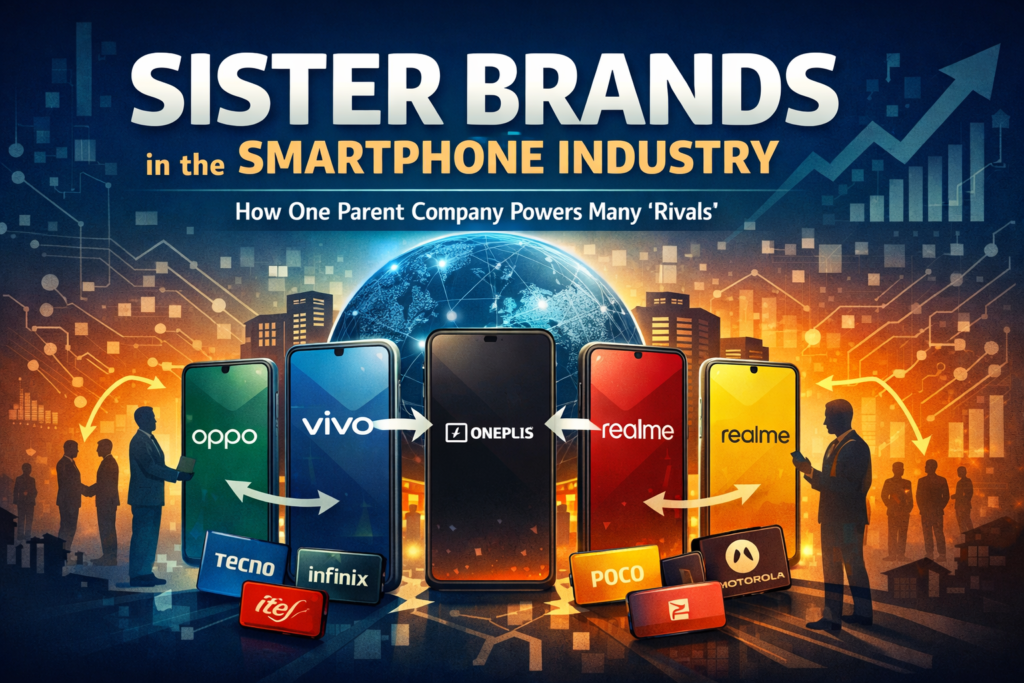
Sister Brands in the Smartphone Industry
A comprehensive global analysis of smartphone sister brands, parent companies, market positioning, economic causes, competitive impact, and long-term industry consequences.
What Are Smartphone Sister Brands?
Sister brands are independent-looking smartphone brands owned by the same parent company. They compete in the marketplace while sharing backend infrastructure such as manufacturing plants, R&D labs, chipset partnerships, and software platforms.
This strategy enables corporations to dominate multiple pricing tiers and geographic regions without weakening brand identity.
Global Market Positioning
The global smartphone industry is primarily structured around a few powerful ecosystems:
- BBK Electronics – Multi-brand expansion model
- Xiaomi Group – Tiered pricing architecture
- Transsion Holdings – Emerging market volume dominance
- Samsung – Vertical integration giant
- Apple – Premium ecosystem monopoly model
Together, these structures account for the majority of global smartphone shipments.
BBK Electronics (China)
Global Position: One of the largest smartphone conglomerates worldwide.
Market Presence: India, China, Europe, Southeast Asia.
Operates: Oppo, Vivo, OnePlus, Realme, iQOO.
Strategic Model
- Control every major price segment
- Internal innovation competition
- Retail shelf dominance
- Audience-based brand positioning
Xiaomi Group
Global Position: Top 5 global vendor by shipments.
Market Focus: India, Europe, Southeast Asia.
Includes: Xiaomi, Redmi, Poco, Black Shark.
Core Strategy
- High specs at competitive pricing
- Online-first distribution
- Fast refresh cycles
Transsion Holdings
Additional Sister Brand Ecosystems
Huawei Technologies
Huawei previously operated Honor as a sub-brand before separation.
Lenovo Group
Owns Motorola and limited Lenovo smartphones.
ZTE Corporation
Controls ZTE, Nubia, RedMagic.
TCL Corporation
Manufactures TCL, Alcatel, BlackBerry.
Nothing Technology
Independent Global Brands
Includes Samsung, Apple, Google, Sony, ASUS, Lava, Micromax, Karbonn, Meizu, Coolpad, Gionee, Hisense, Sharp, Fairphone.
Causes Behind Sister Brand Growth
- Price segmentation complexity
- Declining hardware margins
- Retail competition pressure
- Regional economic disparity
- Supply chain scaling benefits
Pros and Cons of Sister Brand Ecosystems
Advantages
- Wider market penetration
- Accelerated innovation cycles
- Risk diversification
- Greater supplier negotiation power
Disadvantages
- Internal brand cannibalization
- Reduced ownership diversity
- Software fragmentation
- Consumer confusion
Impact on Global Competition
Sister brand structures centralize corporate power while maintaining brand diversity. Consumers see choice, but ownership is increasingly consolidated.
Frequently Asked Questions
Are Oppo, Vivo, OnePlus and Realme owned by the same company?
Yes. They operate under BBK Electronics.
Why do companies create multiple smartphone brands?
To target different pricing tiers and regions without damaging brand identity.
Does this reduce real competition?
Ownership diversity decreases, but visible brand competition remains.
Which ecosystem is most aggressive?
BBK Electronics operates the most layered multi-brand structure.