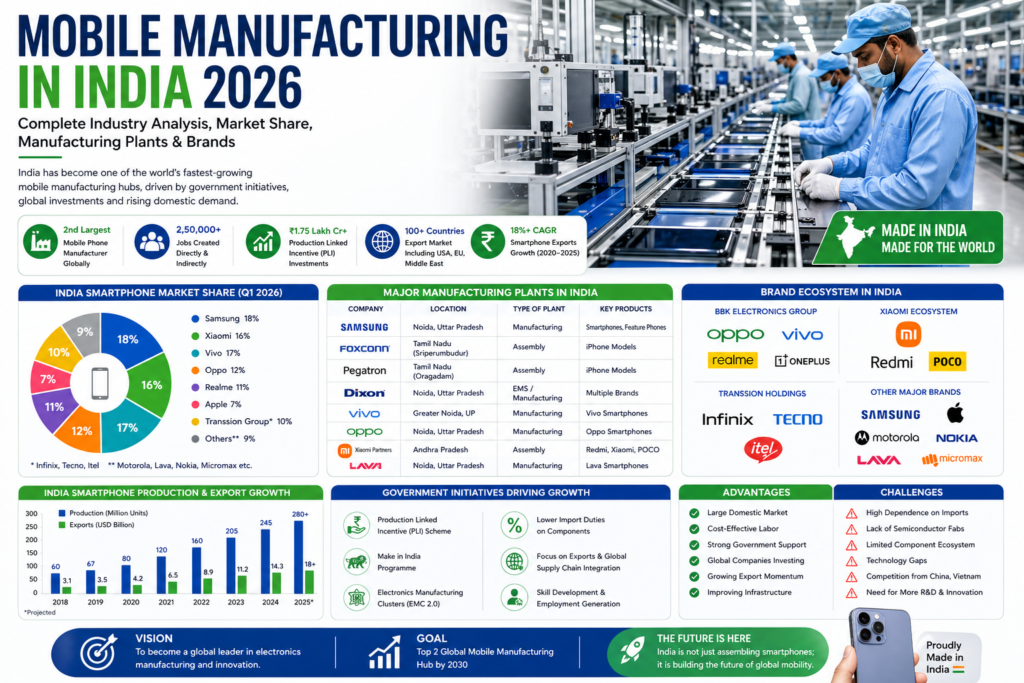
Mobile Device Manufacturing in India – Complete Deep Industry Breakdown (2026)
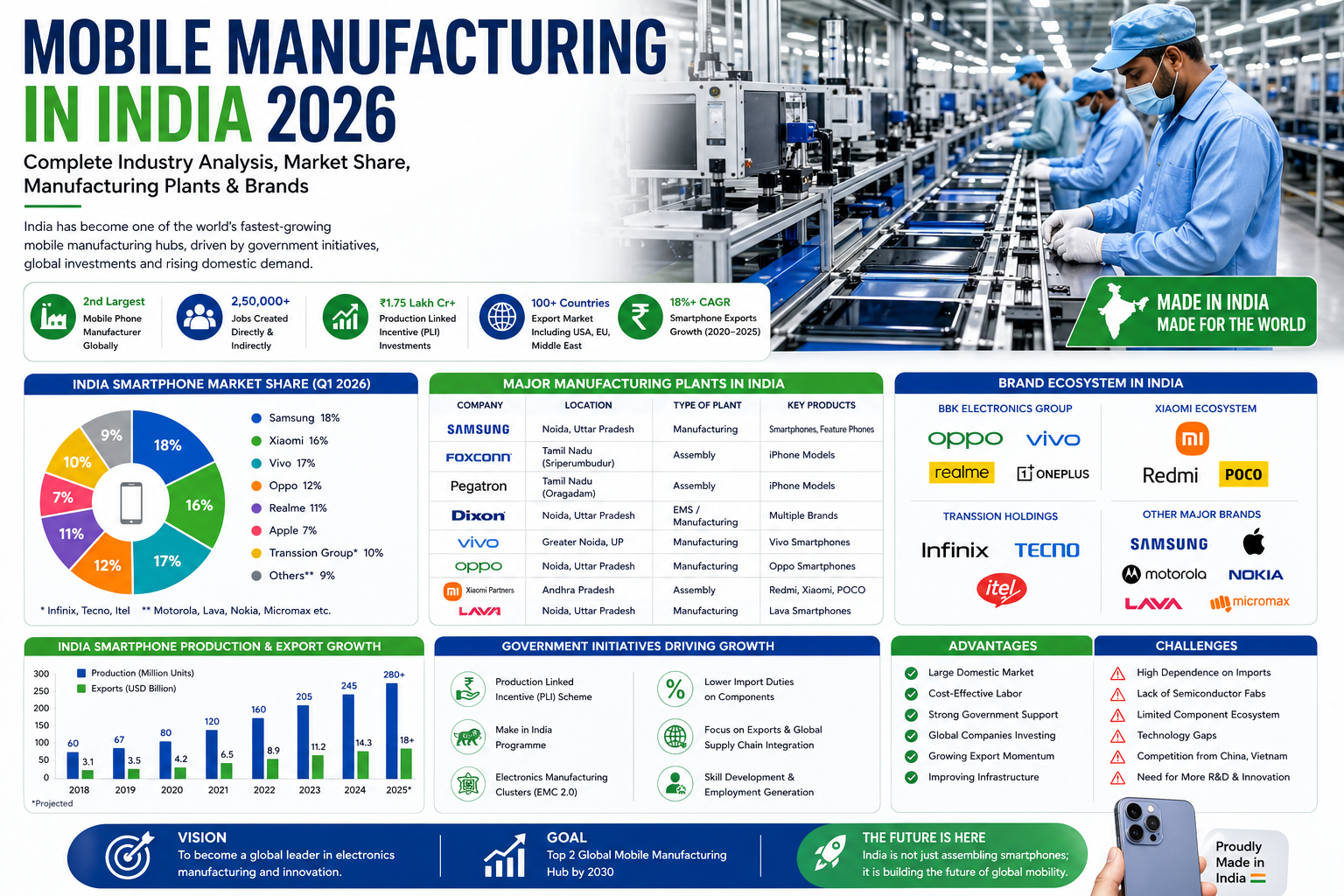
India has evolved into the second-largest mobile manufacturing hub globally, driven by policy incentives, labor cost advantages, and global supply chain diversification. However, the structure of this ecosystem remains assembly-dominant rather than component-driven.
1. Market Share Breakdown (India Smartphone Market 2026)
| Brand | Market Share | Segment Strength |
|---|---|---|
| Samsung | 18% | Full Range |
| Xiaomi | 16% | Budget/Online |
| Vivo | 17% | Offline Retail |
| Oppo | 12% | Camera Phones |
| Realme | 11% | Youth/Performance |
| Apple | 7% | Premium |
| Transsion (Infinix, Tecno, Itel) | 10% | Entry/Budget |
| Others (Motorola, Lava, Nokia) | 9% | Niche |
Chinese-origin brands dominate due to supply chain integration and aggressive pricing strategies. Samsung remains the most balanced player across segments.
2. Major Manufacturing Plants in India
| Company | Location | Function |
|---|---|---|
| Samsung | Noida (UP) | World’s largest phone factory |
| Foxconn | Tamil Nadu | iPhone assembly |
| Pegatron | Chennai | Apple devices |
| Dixon Technologies | Noida | Contract manufacturing |
| Vivo | Greater Noida | Full assembly |
| Oppo | Noida | Manufacturing hub |
| Xiaomi Partners | Andhra Pradesh | Assembly plants |
Noida and Tamil Nadu are the two primary manufacturing clusters, with strong logistics and government support.
3. Brand Hierarchy (Parent, Sub-Brands, Ecosystem)
BBK Electronics Group (China)
- Oppo
- Vivo
- Realme
- OnePlus
Transsion Holdings
- Infinix
- Tecno
- Itel
Xiaomi Ecosystem
- Mi (flagship)
- Redmi (budget)
- POCO (performance)
These multi-brand strategies allow companies to dominate multiple price segments simultaneously without brand dilution.
4. Manufacturing Process Breakdown
4.1 Assembly Stage
- PCB mounting
- Component fitting
- Software flashing
4.2 Localized Components
- Batteries
- Chargers
- Casings
4.3 Imported Components
- Chipsets (Qualcomm, MediaTek)
- Displays (Samsung, BOE)
- Camera sensors (Sony)
5. OEM vs ODM vs EMS Model
India’s manufacturing ecosystem is dominated by EMS (Electronics Manufacturing Services) rather than true OEM innovation.
- OEM: Own design + branding (Apple, Samsung)
- ODM: Design outsourced
- EMS: Pure manufacturing (Dixon, Foxconn)
6. Export Growth Data
| Year | Exports (USD) |
|---|---|
| 2018 | $3 Billion |
| 2020 | $5 Billion |
| 2023 | $11 Billion |
| 2025 | $18+ Billion |
Apple contributes a major share of export growth due to high-value devices.
7. Competitive Advantage of India
- Low labor cost vs China
- Massive domestic demand
- Government incentives
- Geopolitical neutrality
8. Structural Weaknesses
- No advanced semiconductor fabs
- Display manufacturing missing
- High import dependency (~70%)
- Limited R&D ecosystem
9. Future Outlook (2026–2030)
- Semiconductor fabs planned
- Export expansion to EU/US
- Increase in domestic component manufacturing
- Rise of Indian brands
10. Strategic Conclusion
India’s mobile manufacturing story is incomplete but accelerating. The country has solved scale but not depth. The next phase will determine whether India becomes a full-stack electronics powerhouse or remains an assembly hub.